The most expensive mistake in a software project is often made before a single line of code is written: signing with the wrong company. Quotes tend to be reduced to one number and compared, yet the same price can stand for very different scopes, teams and experiences after launch.
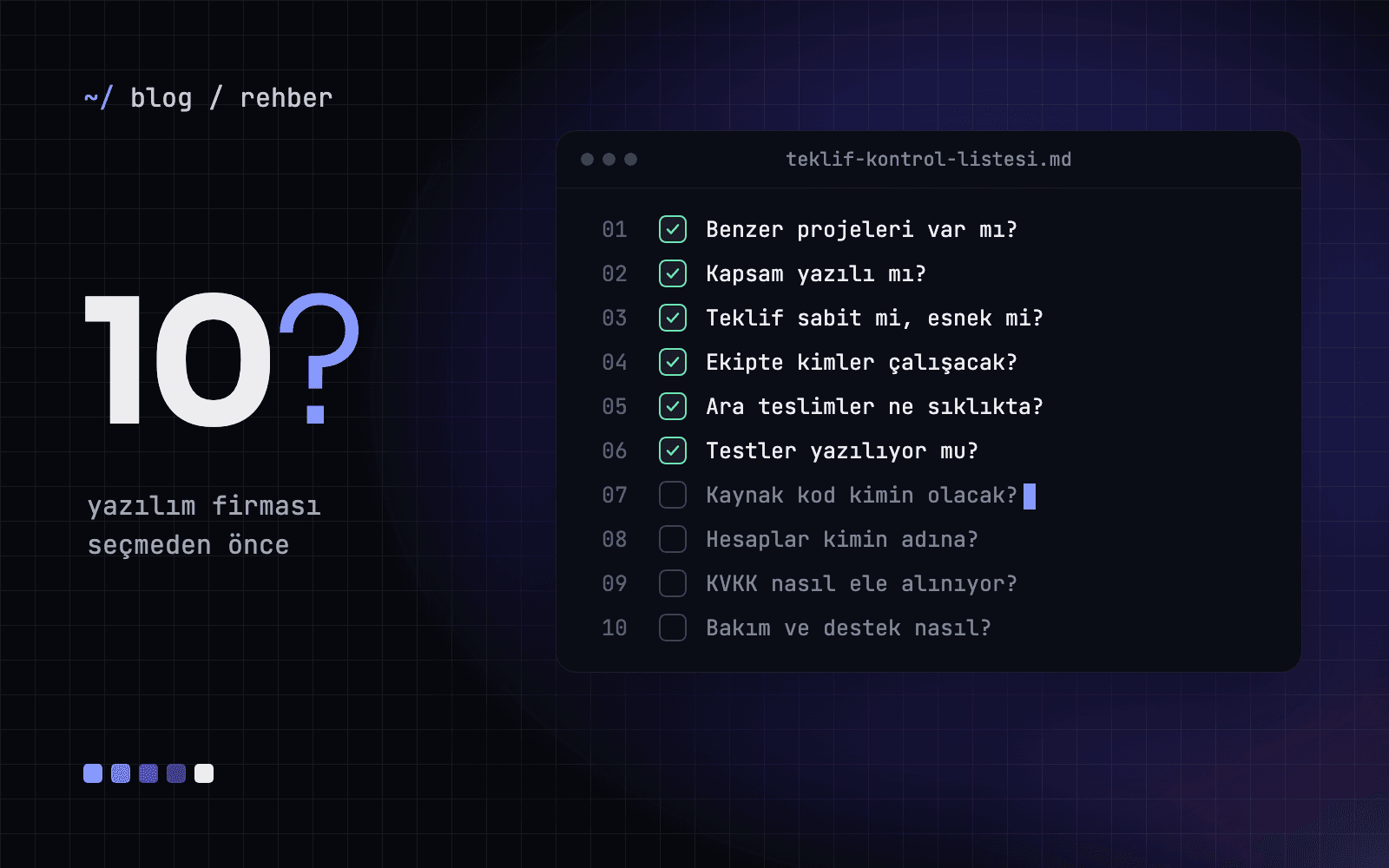
Whether you need a mobile app, a corporate website or web software built around your business, the ten questions below cover what to settle in the first meeting. Under each one we describe what a good answer looks like.
1. Have You Built a Similar Project Before?
A list of references is not enough on its own. What matters is whether they have solved a problem like yours: the same industry, a similar integration or an audience of a similar size. Open one of their live apps or sites together and ask who built which part.
A good answer: A concrete project, a challenge they ran into and how they solved it. "We can do anything" is a warning sign.
2. Will the Scope Be Agreed in Writing?
Most misunderstandings come from assumptions nobody wrote down. The quote should come with a list of screens, user roles, integrations and the work that is explicitly out of scope.
A company that suggests a short discovery phase to pin down the scope usually offers a more realistic schedule than one that names a price in the first meeting.
A good answer: A written scope document and a list of what is out of scope.
3. Is the Quote Fixed or Flexible?
There are two common models: a fixed price, and billing for the time spent. A fixed price makes the budget predictable, but every change of scope becomes a separate negotiation. Billing for time gives flexibility, but it needs regular and transparent reporting.
A fixed price works well when the scope is small and clear.
When the product will take shape along the way (an MVP, a SaaS product), a phased model is healthier.
In both models, how change requests are priced should be written down up front.
4. Who Will Work on the Project?
The people in the sales meeting are not always the team that builds the project. Ask who will work on it, in which roles, and whether any part of the work will be passed on to another company.
A single point of contact speeds up communication, but it matters just as much that this person understands the technical decisions and can explain them to you.
5. How Often Will I See Progress?
Software delivered in one go after months of silence is open to surprises. Seeing a working version every week or two lets you catch anything that goes wrong early.
A good answer: Regular demos, a test environment you can access and a board where you can follow the work.
6. How Do You Ensure Testing and Code Quality?
Code quality is invisible in the first months; you pay for it with every change after launch. Ask whether automated tests are written, who reviews the code before it ships and how releases are made.
The architectural approach matters too: a codebase built on principles such as SOLID lets new features land without breaking the old ones.
7. Who Will Own the Source Code and the Intellectual Property?
Ask this before you sign. Make clear whether the source code is handed over when the project ends, which repository it lives in and what you will face if you want to continue with another team later.
A good answer: The code lives in a repository you can access, and the contract settles the intellectual property rights explicitly.
8. Whose Name Will the Domain, Server and Store Accounts Be In?
The domain, hosting, App Store and Google Play developer accounts, the payment provider... Opening them in the agency’s name looks practical at first but creates a serious dependency later. Ask for the accounts to be opened in your company’s name, with the agency only granted access.
9. How Are Security and Data Protection Handled?
Any software that processes personal data falls under data protection law: the KVKK (Law No. 6698) for users in Turkey and the GDPR for users in the EU. Ask where data is stored, who can access it, how backups are taken and how passwords are protected.
Which country the servers holding the data are in
How access to the admin panel is protected (e.g. two-step verification)
How often backups are taken and how quickly service can be restored
10. How Will Maintenance and Support Work After Launch?
Most of a software product’s life comes after launch. Ask whether there is a maintenance plan for operating system updates, security patches of libraries and small improvements, and how quickly you will hear back when you report a bug.
Also discuss who will update the content: if you can change texts, images and menus yourself from an admin panel, you will not need a support ticket for every small edit.
A Short Checklist for Comparing Quotes
Are the scope and the out-of-scope items written down?
Is the payment plan tied to delivery milestones?
Are the source code and the accounts in your name?
Will you have access to a test environment?
Are the scope and cost of maintenance after launch clear?
Conclusion
The cheapest quote often turns into the most expensive project, but the most expensive quote is not automatically the best either. A company that answers these ten questions clearly and in writing will work with the same openness for the rest of the project.
From our base in Izmir we work with businesses in Izmir, Istanbul, Ankara, Bursa and Antalya. Feel free to ask us these questions too: tell us about your project and we will come back with a written scope and quote.